
Table of Contents
- Introduction: Why Globalization’s Future Is More Uncertain Than Ever
- What Is Globalization? A Quick Refresher
- 5 Major Forces Creating Uncertainty in Globalization
- Deglobalization vs. Reglobalization: What the Data Shows
- Regional Shifts: Who Wins and Loses in a Fragmented World?
- The Future of Global Supply Chains
- Technology and the New Face of Globalization
- Climate Change and Sustainable Globalization
- What Experts Predict: 3 Scenarios for Globalization’s Future
- How Businesses Can Navigate the Uncertain Future
- FAQ
- Conclusion
Introduction: Why Globalization’s Future Is More Uncertain Than Ever
The uncertain future of globalization has become one of the most critical questions facing businesses, governments, and economies worldwide. After decades of increasing integration, the global economic system now stands at a crossroads, buffeted by geopolitical tensions, pandemic disruptions, and fundamental questions about the sustainability of hyper-connected supply chains.
For the first time since World War II, the forces pushing nations apart appear to be gaining strength over those pulling them together. Trade wars, technology decoupling, and the weaponization of economic interdependence have created an environment where the rules of global commerce are being rewritten in real-time.
This comprehensive analysis examines the key factors driving uncertainty in globalization, evaluates competing trends of deglobalization and continued integration, and explores what businesses and policymakers can expect in the years ahead. Whether you’re a business leader reassessing supply chains, an investor evaluating global markets, or simply someone trying to understand our rapidly changing world, understanding these dynamics has never been more important.
The question is no longer whether globalization will change, but how dramatically—and how quickly.
What Is Globalization? A Quick Refresher
Before diving into globalization’s uncertain future, let’s establish a clear understanding of what we mean by the term.
Globalization refers to the increasing interconnectedness and interdependence of world economies through the cross-border flow of goods, services, capital, technology, information, and people. It encompasses economic integration, cultural exchange, and the creation of global supply chains that span multiple countries.
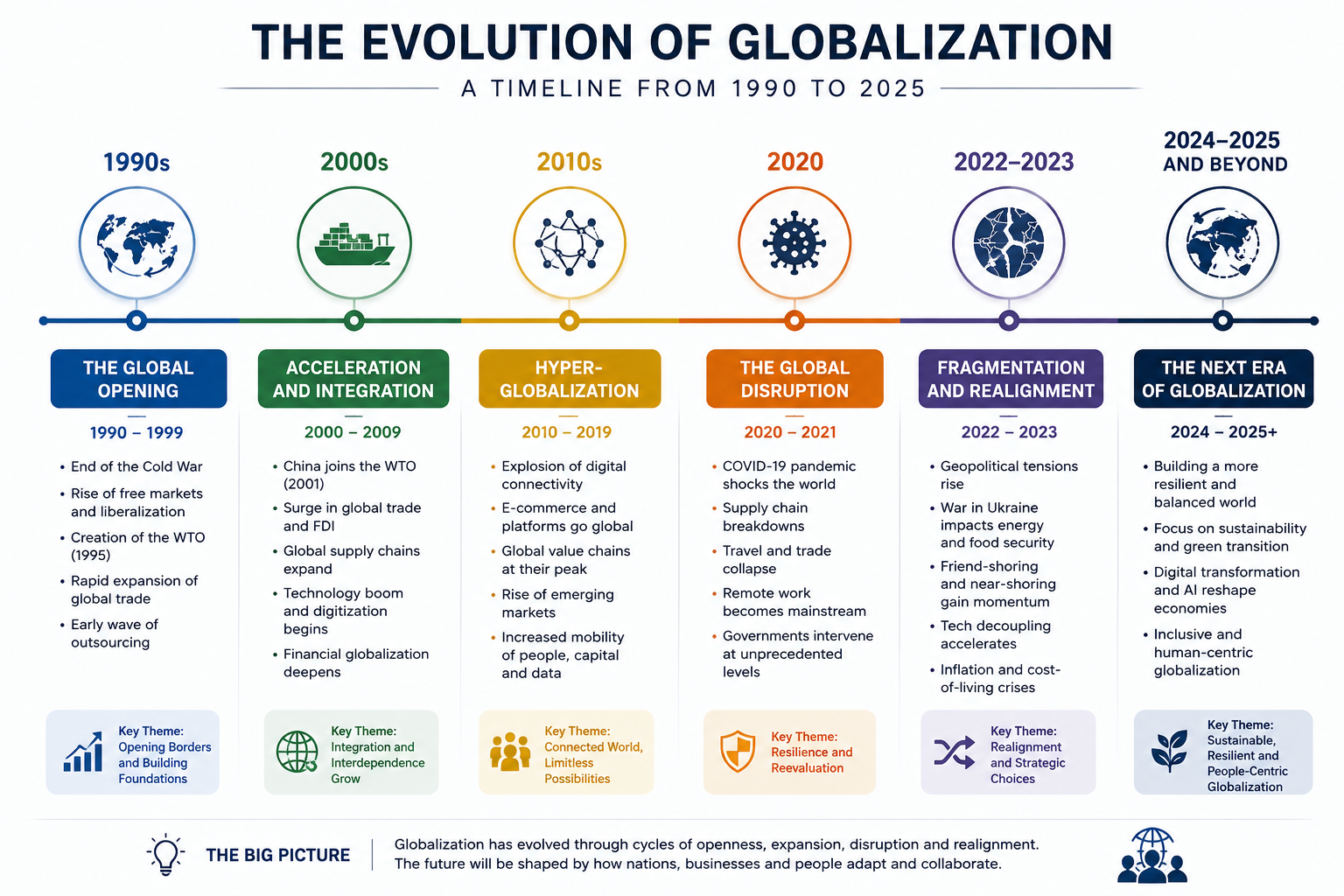
The Golden Age of Globalization (1990-2008)
The fall of the Berlin Wall in 1989 marked the beginning of what many economists call globalization’s “golden age.” This era was characterized by:
- Dramatic reduction in trade barriers following GATT and WTO agreements
- China’s integration into the global trading system after joining the WTO in 2001
- Technology revolution enabling instant global communication and coordination
- Rapid growth in foreign direct investment (FDI) across borders
- Emergence of complex global value chains where products were manufactured across multiple countries
- Explosion in container shipping making goods transport cheaper than ever
During this period, global trade grew at roughly twice the rate of global GDP, companies expanded internationally at unprecedented rates, and hundreds of millions were lifted out of poverty in emerging markets.
Key Drivers That Propelled Global Integration
Several interconnected forces drove this remarkable integration:
- Technological advancement: The internet, mobile communications, and logistics innovations collapsed distance and time barriers
- Political consensus: A broad agreement among major economies that open trade benefited all parties
- Economic efficiency: The pursuit of comparative advantage and cost optimization through global sourcing
- Financial liberalization: Removal of capital controls allowing money to flow freely across borders
- Standardization: Development of common technical, legal, and regulatory frameworks
This golden age created the deeply interconnected world we know today—but also planted the seeds of today’s uncertainty.
Major Forces Creating Uncertainty in Globalization
The uncertain future of globalization stems from five powerful forces that are reshaping the global economic landscape.
1. Geopolitical Tensions and Great Power Competition
The most significant threat to globalization comes from intensifying rivalry between major powers, particularly the United States and China.
U.S.-China Strategic Competition: What began as trade disputes has evolved into comprehensive strategic competition across technology, military power, and global influence. This rivalry is forcing countries and companies to choose sides, fragmenting what was once a unified global market.
The New Cold War Narrative: Some analysts argue we’re entering a new bipolar world order, with competing spheres of influence replacing the post-Cold War unipolar moment. This creates fundamental uncertainty about which rules, standards, and systems will govern global commerce.
Regional Flashpoints: Taiwan, the South China Sea, Ukraine, and other geopolitical tensions create risks that can suddenly disrupt global trade flows and investment patterns.
2. Trade Wars and Protectionist Policies
The era of steadily declining tariffs has reversed, with major economies implementing protectionist measures:
Tariff Escalation: U.S. tariffs on Chinese goods, retaliatory measures, and the proliferation of trade barriers globally have increased the cost of cross-border commerce.
Industrial Policy Resurgence: Governments are actively intervening to support domestic industries through subsidies, local content requirements, and preferential treatment—policies once considered outdated are making a comeback.
Decoupling Rhetoric: Political leaders increasingly frame trade policy in zero-sum terms rather than the win-win language that dominated previous decades.
According to the World Trade Organization, new trade restrictions have multiplied in recent years, with protectionist measures growing faster than trade-liberalizing ones for the first time in decades.
3. Supply Chain Vulnerabilities Exposed by COVID-19
The pandemic revealed critical weaknesses in global supply chains optimized for efficiency over resilience:
The “Just-in-Time” Failure: When borders closed and factories shuttered, companies discovered they had no buffer inventory and no alternative sources for critical components.
Concentration Risks: Dependence on single countries or regions for essential goods (masks, semiconductors, pharmaceuticals) created national security concerns.
Fragility of Complex Chains: The more globally dispersed a supply chain, the more vulnerable it proved to simultaneous disruptions across multiple geographies.
The Great Reassessment: Businesses and governments are fundamentally reconsidering the trade-off between cost efficiency and supply security, often concluding that building resilient supply chains requires bringing production closer to home.
4. Rise of Economic Nationalism
Political movements prioritizing national interests over global integration have gained strength worldwide:
Populist Backlash: In many developed countries, voters who felt left behind by globalization have empowered leaders promising to put “our country first.”
Job Protection Rhetoric: Politicians face intense pressure to prevent offshoring and bring manufacturing jobs home, regardless of economic efficiency arguments.
Sovereignty Concerns: Increased sensitivity about dependence on foreign nations for critical technologies, resources, and capabilities.
Social Contract Renegotiation: Growing recognition that globalization created winners and losers within countries, not just between them, leading to demands for different policies.
5. Technology Decoupling and Digital Sovereignty
Perhaps most significantly for globalization’s future, the technology sector—once the most globally integrated—is fragmenting:
Semiconductor Wars: The U.S. and allies are restricting China’s access to advanced chip technology while China invests heavily in semiconductor self-sufficiency.
Splinternet Emergence: Different regulatory regimes (China’s Great Firewall, EU’s digital regulations, U.S. approach) are creating separate digital ecosystems.
Data Localization: Countries increasingly require that data generated within their borders be stored locally, hindering global digital services.
Technology Standards Competition: Competing 5G, AI, and other technology standards threaten to create incompatible global systems.
Export Controls: Advanced technologies increasingly subject to export restrictions on national security grounds.
These five forces interact and reinforce each other, creating a fundamentally more uncertain environment for globalization than existed just a decade ago.
Deglobalization vs. Reglobalization: What the Data Shows
The debate about globalization’s future often presents a binary choice: are we experiencing deglobalization or continued globalization? The reality is more nuanced—different sectors are moving in different directions simultaneously.
Evidence of Deglobalization Trends
Several data points suggest global integration is reversing:
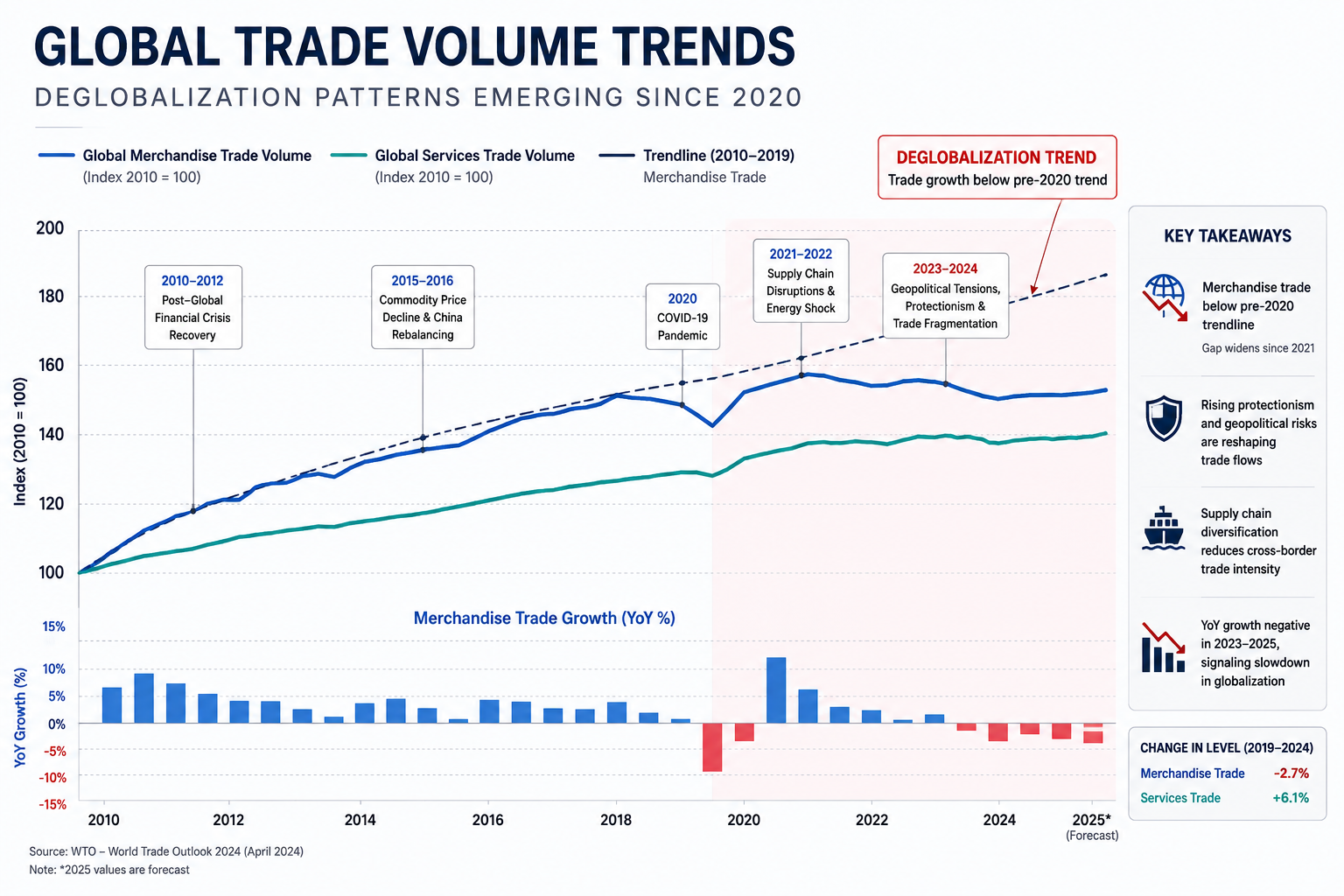
Trade-to-GDP Ratios Declining: After peaking around 2008, global trade as a percentage of GDP has stagnated or declined in many regions. The ratio of global trade to GDP, which rose from about 39% in 1990 to 61% in 2008, has failed to regain those heights.
Foreign Direct Investment Plateaus: Cross-border investment flows, when adjusted for financial flows and measured in real terms, show much slower growth than in previous decades.
Reshoring Momentum: Surveys consistently show companies moving production back to home countries or nearby regions. The Reshoring Initiative reports growing numbers of U.S. companies bringing manufacturing home.
Trade Policy Reversals: The number of trade-restrictive measures implemented globally now exceeds trade-liberalizing measures, reversing decades of trend.
Shorter Supply Chains: Research shows companies actively reducing supply chain length and complexity, bringing suppliers geographically closer.
Sectors Still Experiencing Globalization Growth
However, other data points to continued or even accelerating integration in certain areas:
Digital Services Boom: Cross-border data flows and digital services trade continue growing rapidly. The McKinsey Global Institute found that global data flows increased 45-fold between 2005 and 2020.
E-commerce Globalization: Cross-border e-commerce continues expanding, connecting consumers and businesses across borders in new ways.
Knowledge Flows: Scientific collaboration, research partnerships, and intellectual property licensing remain highly globalized.
Capital Markets: Financial markets remain deeply integrated, with capital moving globally at speeds and scales exceeding the pre-2008 era.
Services Trade: While goods trade has stagnated, services trade (especially digital services) continues growing as a share of global commerce.
The “Slowbalization” Phenomenon
Many economists argue we’re experiencing neither full deglobalization nor continued hyper-globalization, but rather “slowbalization”—a distinct phase characterized by:
Slower, Not Reversed Integration: Global trade continues growing, but at rates similar to or below GDP growth rather than multiples of it.
Selective Integration: Countries and companies integrating deeply with trusted partners while limiting engagement with geopolitical rivals.
Vertical vs. Horizontal Shifts: Reduced horizontal trade in goods but increased vertical integration in services, data, and specialized knowledge.
Regional Over Global: Strengthening of regional trade blocs while global multilateral institutions weaken.
Quality Over Quantity: Focus shifting from volume of cross-border flows to reliability, security, and sustainability of those flows.
The data suggests we’re not returning to the autarkic nationalism of the 1930s, but neither are we continuing the rapid globalization of the 1990s-2000s. Instead, we’re entering a new phase where the uncertain future of globalization manifests as increased volatility, selectivity, and regionalization.
Regional Shifts: Who Wins and Loses in a Fragmented World?
As globalization fragments, the economic geography of the world is being redrawn. Different regions and countries are positioning themselves to either benefit from or mitigate the risks of this transformation.
China’s Changing Role in Global Trade
China’s position in global trade is undergoing fundamental transformation:
From “World’s Factory” to Selective Integration: China is no longer pursuing integration with all markets equally, instead prioritizing relationships with countries in its Belt and Road Initiative and those not aligned with U.S. restrictions.
Dual Circulation Strategy: Beijing’s policy emphasizes strengthening domestic consumption and production (internal circulation) while maintaining selective international engagement (external circulation).
Moving Up the Value Chain: China is deliberately transitioning from low-cost manufacturing to high-tech production, competing directly with developed economies in advanced sectors.
Regional Influence Expansion: Through RCEP (Regional Comprehensive Economic Partnership) and bilateral agreements, China is strengthening ties with Asian neighbors while Western relations cool.
Vulnerabilities: Dependence on imported semiconductors, energy, and food creates strategic weaknesses China is working to address through self-sufficiency programs.
The U.S. Reshoring and Friend-Shoring Strategy
The United States is pursuing a deliberate strategy to restructure global supply chains:
Reshoring Critical Industries: Tax incentives, subsidies (like the CHIPS Act), and policy support are bringing semiconductor manufacturing, pharmaceutical production, and other strategic industries back to U.S. soil.
Friend-Shoring Framework: Rather than complete reshoring, the U.S. is encouraging companies to relocate supply chains to allied nations (Japan, South Korea, EU members, etc.) that share values and strategic interests.
North American Integration: Deepening economic integration with Mexico and Canada through near-shoring, creating a regional manufacturing bloc to compete with Asia.
Technology Leadership Protection: Export controls, investment screening, and research security measures aimed at maintaining U.S. advantage in critical technologies.
Trade Policy Selectivity: Moving away from multilateral trade agreements toward bilateral deals with strategic partners.
Europe’s Struggle for Strategic Autonomy
The European Union faces unique challenges in navigating the uncertain future of globalization:
Caught in the Middle: Europe seeks to maintain economic ties with both the U.S. and China while avoiding complete dependence on either.
Strategic Autonomy Goals: The EU is developing policies for greater self-sufficiency in critical technologies, defense, and energy following Ukraine crisis lessons.
Regulatory Power: Europe is leveraging its regulatory authority (GDPR, Digital Markets Act, Carbon Border Adjustment Mechanism) to shape global standards even as its economic influence potentially wanes.
Internal Tensions: Member states disagree on China policy, with some (Germany) prioritizing economic ties and others (Eastern European states) more wary.
Energy Transition Leadership: Europe’s aggressive climate policies and green technology development may position it well in a carbon-constrained future global economy.
Supply Chain Vulnerabilities: Heavy dependence on China for manufacturing and critical inputs creates risks Europe is slowly addressing through industrial policy.
Emerging Markets: The New Globalization Hubs?
Several emerging markets are positioning themselves as winners in a fragmenting global economy:
Vietnam: Already a major beneficiary of supply chain diversification, attracting manufacturing from China with competitive labor costs, political stability, and strategic location.
India: “China Plus One” strategies and India’s massive market make it attractive for companies seeking alternatives. Government initiatives like “Make in India” and improving business climate enhance appeal.
Mexico: Geographic proximity to the U.S. market, USMCA benefits, and competitive manufacturing capabilities are driving unprecedented nearshoring investment.
Indonesia: Southeast Asia’s largest economy is attracting investment in electronics, electric vehicles, and resource processing as companies diversify.
Poland and Central Europe: Becoming manufacturing hubs for the European market with skilled labor, EU access, and lower costs than Western Europe.
UAE and Gulf States: Positioning as neutral trading hubs between East and West, investing in logistics infrastructure and diversified economies.
Challenges for Emerging Markets: Infrastructure gaps, governance issues, and smaller domestic markets mean emerging economies must navigate carefully to capture benefits without becoming pawns in great power competition.
The regional winners in globalization’s transformation will be those that combine competitive advantages with political stability, infrastructure quality, and strategic positioning between major powers.
The Future of Global Supply Chains
Supply chains are at the heart of the uncertain future of globalization. How companies organize production and distribution networks will fundamentally shape global economic integration.
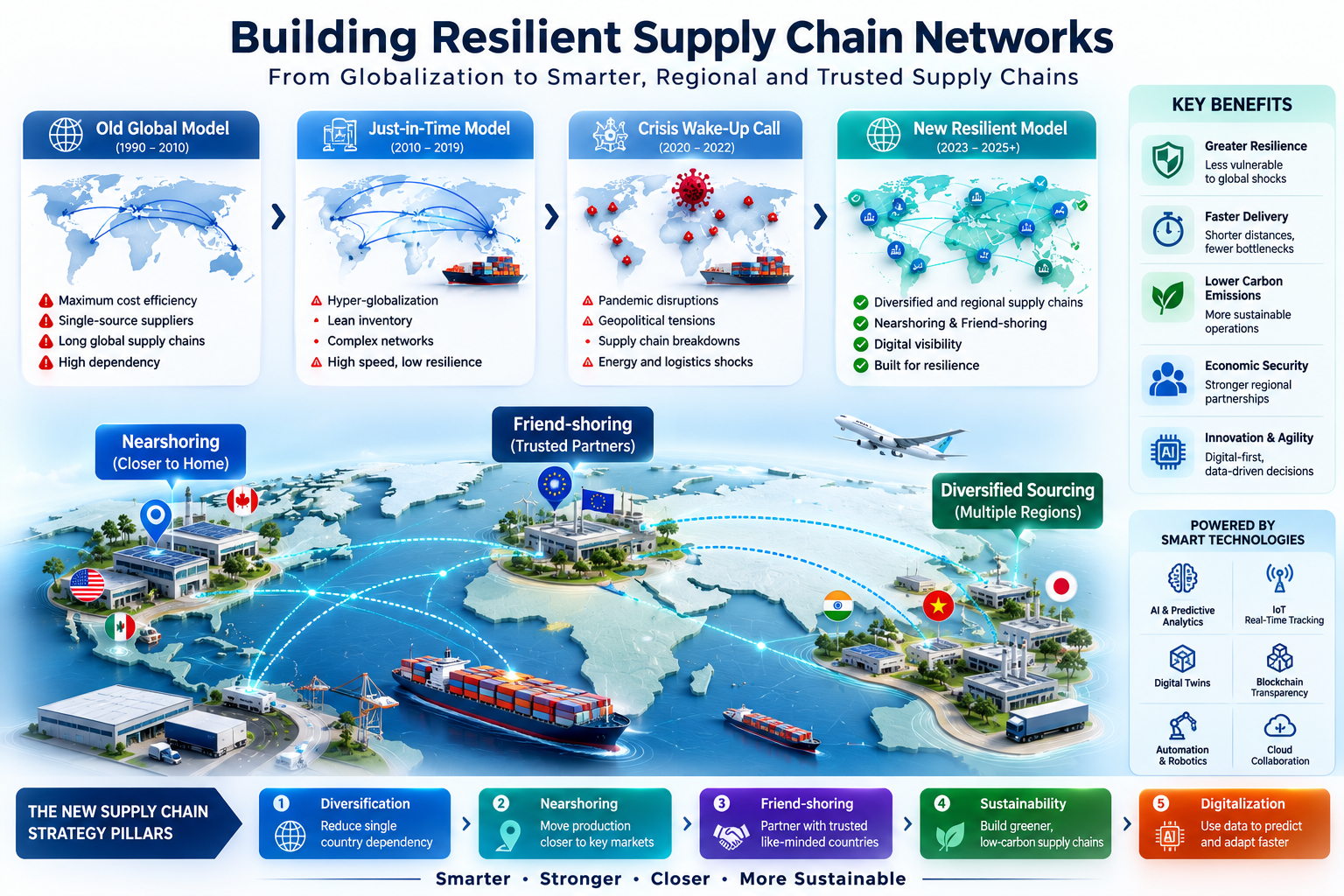
From Just-in-Time to Just-in-Case
The pandemic exposed critical vulnerabilities in supply chains optimized purely for cost efficiency:
The Just-in-Time Model: For decades, companies minimized inventory through precise coordination, reducing capital tied up in stock and warehouse space. This model assumed reliable, predictable supply flows.
Pandemic Disruption: When disruptions hit simultaneously across the globe, companies without buffer inventory faced production shutdowns and lost sales.
The Just-in-Case Approach: Companies are now building redundancy into supply chains through:
- Higher safety stock levels
- Multiple suppliers for critical components
- Geographically distributed production capacity
- Greater vertical integration of critical inputs
- Scenario planning for disruption resilience
The Cost Trade-Off: Building resilience increases costs, potentially raising prices for consumers and reducing profit margins. Companies must balance efficiency and resilience based on product criticality and market dynamics.
Selective Application: Not all products warrant expensive resilience measures. Companies are developing tiered approaches: maximum resilience for critical/strategic goods, efficiency for commodities.
Nearshoring and Regional Trade Blocs
Geographic concentration of supply chains in Asia is giving way to regional diversification:
Nearshoring Advantages:
- Reduced transportation time and costs
- Lower tariff exposure within regional trade agreements
- Better quality control and oversight
- Easier response to market changes
- Reduced geopolitical risk
Regional Trade Blocs Strengthening:
- USMCA (United States-Mexico-Canada Agreement): Driving North American manufacturing integration
- RCEP (Regional Comprehensive Economic Partnership): Creating Asia-Pacific economic bloc
- African Continental Free Trade Area (AfCFTA): Potentially transforming African economies through regional integration
- European Single Market: Deepening despite Brexit
The “China Plus” Strategy: Rather than complete exit, many companies maintain Chinese operations while establishing alternative capacity in Vietnam, India, Thailand, or other locations.
Infrastructure Requirements: Nearshoring success requires significant investment in manufacturing facilities, logistics networks, and supplier ecosystems in new locations.
Technology’s Role in Supply Chain Resilience
Advanced technologies are enabling new approaches to supply chain management:
Digital Twins: Virtual replicas of supply chains allow companies to simulate disruptions and test response strategies without real-world risks.
AI and Predictive Analytics: Machine learning identifies potential disruptions before they occur, enabling proactive responses.
Blockchain for Transparency: Distributed ledger technology provides real-time visibility into complex supply chains, helping identify vulnerabilities.
Additive Manufacturing: 3D printing allows on-demand production closer to end markets, reducing dependence on long supply chains for certain products.
Autonomous Logistics: Automated warehouses, delivery vehicles, and inventory management systems increase efficiency even with shorter, more complex supply chains.
IoT Sensors: Real-time monitoring of shipments, inventory, and production processes provides unprecedented visibility.
The future of global supply chains will be more regional, more resilient, and more technologically sophisticated—but also more expensive and complex to manage. Companies that successfully navigate this transformation will gain competitive advantage; those that cling to old models face existential risk.
Technology and the New Face of Globalization
While physical goods trade shows signs of deglobalization, technology is creating new forms of global integration that may define globalization’s future.
Digital Services vs. Physical Goods Trade
A fundamental shift is occurring in what moves across borders:
Goods Trade Plateaus: Cross-border movement of physical products is growing slowly or declining in many categories.
Services Trade Accelerates: Digital services—software, cloud computing, streaming entertainment, professional services delivered remotely—are growing rapidly.
Data as the New Oil: Cross-border data flows have become more economically valuable than traditional goods trade in many sectors.
Remote Work Globalization: The pandemic normalized remote work, enabling companies to access global talent pools without physical relocation.
Comparison of Value:
- McKinsey estimates that cross-border data flows generate more economic value than traditional goods trade
- Digital services can be delivered instantly globally without shipping costs or physical infrastructure
- Knowledge-intensive services face fewer protectionist barriers than manufactured goods (though this is changing)
Implications: Countries without manufacturing capacity can participate in globalization through digital services; educational systems and digital infrastructure become more critical than traditional industrial policy.
The Metaverse and Virtual Globalization
Emerging technologies may create entirely new forms of global integration:
Virtual Economies: Digital goods, virtual real estate, and metaverse economies operate without physical borders or traditional trade barriers.
NFTs and Digital Ownership: Blockchain-based ownership of digital assets creates new forms of cross-border commerce.
Virtual Collaboration: Immersive technologies enable global teams to work together in shared virtual spaces, transcending physical distance.
Digital Identity: Universal digital identities could facilitate seamless cross-border transactions and services.
Challenges: Regulatory fragmentation, data sovereignty concerns, and digital divides could fragment virtual globalization just as physical globalization is fragmenting.
AI, Automation, and Cross-Border Competition
Artificial intelligence is transforming the economics of global production:
Reshoring Economics: Automation reduces the labor cost advantage of low-wage countries, making production in developed economies more viable.
AI-Driven Customization: Machine learning enables mass customization at scale, favoring production closer to end markets.
Knowledge Work Globalization: AI tools enable global competition in professional services previously protected by local expertise requirements.
Winner-Take-All Dynamics: Network effects and data advantages in AI may create global technology monopolies, concentrating economic power.
New Skill Demands: The competitive advantage shifts from low-cost labor to AI/tech capabilities, benefiting different countries than traditional globalization.
Technology is not reversing globalization but transforming it—from movement of physical goods to flow of data, from labor-intensive manufacturing to knowledge-intensive services, from geographic comparative advantage to technological capabilities. Understanding this transformation is critical to navigating the uncertain future of globalization.
Climate Change and Sustainable Globalization
Environmental concerns are emerging as a major force reshaping globalization, potentially creating new forms of fragmentation while demanding global cooperation.
Carbon Border Adjustments and Green Trade Wars
Climate policy is becoming trade policy:
Carbon Border Adjustment Mechanisms (CBAM): The EU’s pioneering policy imposes charges on imports from countries with weaker climate regulations, effectively creating a “carbon tariff.”
Competitive Dynamics: Countries may implement retaliatory measures or matching carbon policies, creating complex new trade barriers.
Green Subsidies: Massive government support for green technologies (U.S. Inflation Reduction Act, EU Green Deal) creates trade tensions as countries compete for green industries.
Standards Fragmentation: Different carbon accounting methods, sustainability standards, and environmental regulations create complexity for global businesses.
Developed vs. Developing Tensions: Developing countries argue carbon border adjustments punish them for industrialization developed countries completed without environmental constraints.
The Green Technology Race: Competition for leadership in electric vehicles, renewable energy, batteries, and other green technologies is intensifying, with strategic implications similar to semiconductor competition.
The Push for Localized, Sustainable Production
Environmental concerns are adding another reason to shorten supply chains:
Transportation Emissions: Long-distance shipping contributes significantly to carbon emissions; shorter supply chains reduce environmental footprint.
Circular Economy Models: Local production enables easier recycling, reuse, and waste management in closed-loop systems.
Sustainable Agriculture: Pressure for locally-sourced food reduces global agricultural trade while raising food security concerns.
Consumer Preferences: Growing consumer demand for sustainable, locally-produced goods affects corporate sourcing decisions.
Resilience Co-Benefits: Localized production for sustainability also delivers supply chain resilience, creating reinforcing incentives.
Challenges: Local production in all regions may be less efficient and more resource-intensive than specialized global production; determining optimal balance requires complex lifecycle analysis.
Climate change presents a paradox for globalization: it demands unprecedented global cooperation to address a truly planetary challenge while simultaneously creating new reasons for localized production and economic fragmentation. How the world navigates this tension will significantly influence globalization’s trajectory.
The uncertain future of globalization may ultimately be shaped as much by environmental sustainability requirements as by geopolitical competition or economic efficiency considerations.
What Experts Predict: 3 Scenarios for Globalization’s Future
Leading economists, strategists, and international relations experts offer divergent views on where globalization is heading. Most analysis converges on three plausible scenarios.
Scenario 1: Continued Fragmentation
The Pessimistic View: Globalization continues unraveling as geopolitical competition intensifies.
Key Characteristics:
- U.S.-China decoupling deepens across technology, trade, and finance
- World divides into competing economic blocs with limited interaction
- Multilateral institutions (WTO, IMF, World Bank) become irrelevant
- Technology standards diverge into incompatible systems
- Reduced global growth and efficiency as economies duplicate capabilities
- Increased risk of military conflict as economic interdependence declines
Probability Drivers:
- Taiwan conflict or similar major geopolitical crisis
- Domestic political pressure in major economies for economic nationalism
- Technology decoupling reaches point of no return
- Climate change creates resource scarcity and migration pressures
Economic Impact:
- Global GDP potentially 5-10% lower than integrated alternative
- Emerging markets face difficult choices about bloc alignment
- Innovation slows as researchers and ideas flow less freely
- Consumers face higher prices and less product variety
Historical Parallel: The interwar period (1919-1939) when globalization collapsed into autarkic nationalist blocs, ultimately culminating in World War II.
Expert Voices: Some realist international relations scholars and economic nationalists see this scenario as likely or even desirable for national security.
Scenario 2: Selective Globalization
The Middle Path: Globalization continues but becomes more selective, regulated, and regional.
Key Characteristics:
- “Friend-shoring” becomes the dominant model—deep integration with trusted partners, limited engagement with rivals
- Regional trade blocs strengthen while global multilateralism weakens
- Critical industries and technologies are protected; other sectors remain globalized
- Digital services and data flows continue growing despite goods trade slowdown
- Sustainability requirements create new trade frameworks
- Managed interdependence replaces naive integration
Probability Drivers:
- Continuation of current trends without major crisis or resolution
- Business pressure for some global integration combined with government security concerns
- Recognition that complete decoupling is economically devastating
- Climate change requires cooperation on some issues despite competition on others
Economic Impact:
- Modest global GDP reduction (2-4%) compared to full integration
- Higher costs for some goods, continued efficiency in services
- Innovation continues but with more regional concentration
- Winners: Countries positioned as trusted partners or neutral hubs
- Losers: Small countries unable to align with major blocs
Historical Parallel: The Cold War period, when East-West blocs maintained some economic interaction while ideologically opposed, combined with regional integration efforts like the EU.
Expert Voices: Many mainstream economists, business strategists, and policy analysts see this as the most likely scenario—already underway and sustainable long-term.
Scenario 3: Renewed Multilateralism
The Optimistic View: After a period of disruption, shared challenges drive renewed global cooperation.
Key Characteristics:
- Climate change urgency forces unprecedented international cooperation
- New multilateral institutions replace or reform ineffective existing ones
- Technology cooperation frameworks prevent complete decoupling
- Pandemic preparedness and health security drive integration
- Trade agreements include labor, environmental, and social standards
- Digital globalization accelerates with governance frameworks
- China and the West find accommodation frameworks
Probability Drivers:
- Climate catastrophe creates undeniable urgency
- Pandemic or other global crisis demonstrates interdependence value
- Leadership changes in major powers
- Technological solutions reduce zero-sum resource competition
- Younger generations prioritize global cooperation
Economic Impact:
- Highest global GDP growth potential
- Rapid innovation through global knowledge sharing
- Emerging markets develop fastest with global capital and technology access
- Inequality between and within countries potentially addressed through cooperation
Historical Parallel: The post-World War II creation of Bretton Woods institutions, UN, and rules-based international order following catastrophic conflict.
Expert Voices: Progressive internationalists, some business leaders, climate activists, and global governance advocates hope for this scenario but acknowledge current trends move against it.
Which Scenario Is Most Likely?
Current Trajectory: We appear to be on the path toward Scenario 2 (Selective Globalization), with elements of Scenario 1 (Fragmentation) appearing in technology and strategic industries.
Critical Decision Points:
- 2025-2027: U.S.-China relations either stabilize or deteriorate further
- Climate impacts accelerate, potentially forcing cooperation
- Technology decoupling either completes or reverses
- Economic costs of fragmentation become clear, influencing policy
Regional Variation: Different regions may experience different scenarios—East Asia might remain more integrated while U.S.-China relations fragment; Europe might pursue selective globalization while others choose sides.
Most experts believe we won’t return to the hyper-globalization of 2000-2008, but complete deglobalization also appears unlikely given the enormous costs. The uncertain future of globalization will most likely be characterized by selectivity, regionalization, and strategic management rather than either complete integration or total fragmentation.
How Businesses Can Navigate the Uncertain Future
For business leaders, the uncertain future of globalization presents both risks and opportunities. Success requires strategic flexibility and proactive adaptation.
Diversification Strategies
Don’t Put All Eggs in One Basket: The cardinal rule for navigating uncertainty is diversification across multiple dimensions.
Geographic Diversification:
- Maintain production capacity in multiple regions to mitigate single-country risk
- Develop market presence in various geographies to reduce dependence on any single market
- Consider “China plus” strategies rather than complete exit or exclusive reliance
Supplier Diversification:
- Qualify multiple suppliers for critical components
- Avoid sole-source dependencies that create vulnerability
- Balance cost efficiency with supply security
Product/Service Diversification:
- Don’t rely exclusively on products subject to trade restrictions
- Develop capabilities across physical goods and digital services
- Create offerings valuable in multiple regulatory/political environments
Implementation Challenges: Diversification increases complexity and costs; businesses must determine appropriate levels based on product criticality and margin capacity.
Building Resilient Supply Chains
Resilience Investment Areas:
Visibility: Implement technology providing real-time supply chain transparency—know where everything is, identify bottlenecks quickly.
Redundancy: Accept higher costs of backup suppliers, safety stock, and alternative production capacity for critical items.
Flexibility: Develop manufacturing and distribution systems that can quickly shift between suppliers, routes, and products.
Partnerships: Deepen relationships with strategic suppliers through long-term contracts, joint investments, and collaborative planning.
Scenario Planning: Regularly conduct exercises simulating various disruptions (pandemic, war, natural disaster, trade restrictions) and test response capabilities.
Risk Assessment: Continuously evaluate geopolitical, environmental, and economic risks across all supply chain nodes.
Practical Steps:
- Map complete supply chain to identify all critical dependencies
- Assess vulnerability of each node to various disruption scenarios
- Prioritize resilience investments based on criticality and risk
- Implement monitoring systems for early warning
- Develop and rehearse contingency plans
- Review and update quarterly as conditions change
Investing in Regional Markets
Regional Strategy Development:
North America: USMCA creates integrated market; Mexico particularly attractive for nearshoring; U.S. offers technology and high-value markets.
Europe: Large, wealthy market with strict regulations; sustainability leaders; potential challenges from energy costs and regulatory complexity.
Southeast Asia: Fast-growing manufacturing alternative to China; RCEP creates large integrated market; infrastructure development ongoing.
India: Massive market with improving business environment; “China plus one” destination; challenges remain in bureaucracy and infrastructure.
Africa: Long-term growth potential; AfCFTA creates opportunities; requires patient capital and partnership approaches.
Latin America: Beyond Mexico, Brazil and others offer nearshoring possibilities for Americas; political and economic volatility requires careful assessment.
Regional Approach Benefits:
- Reduced transportation costs and time
- Lower tariff exposure within trade blocs
- Better understanding of local customer needs
- Reduced geopolitical risk compared to global strategies
- Easier regulatory compliance within harmonized regional frameworks
Investment Considerations:
- Infrastructure quality and reliability
- Political stability and rule of law
- Labor availability and skill levels
- Market access through trade agreements
- Regulatory environment and bureaucracy
- Currency stability and capital controls
Strategic Flexibility as Core Competency
The Meta-Strategy: In an uncertain environment, the ability to adapt quickly becomes more valuable than optimizing for any single scenario.
Building Adaptive Capability:
- Modular operations that can be reconfigured
- Cross-training employees for multiple roles
- Technology platforms enabling rapid change
- Financial reserves for unexpected opportunities or necessities
- Decision processes that can move quickly when needed
Monitoring and Intelligence:
- Dedicated resources tracking geopolitical developments
- Participation in industry associations and government consultations
- Scenario planning as regular business practice
- Relationships with experts and advisors across regions
Cultural Adaptation:
- Leadership comfortable with ambiguity
- Organization accepting of strategy changes
- Learning culture that captures lessons from disruptions
- Balance of centralized strategic direction with local operational flexibility
The businesses that thrive amid the uncertain future of globalization will be those that treat adaptability as a competitive advantage, make strategic resilience investments, and position themselves to benefit regardless of which scenario unfolds.
Frequently Asked Questions About the Future of Globalization
Is globalization ending?
Globalization is not ending, but it is transforming. We’re seeing a shift from hyper-globalization to “selective globalization” where countries prioritize trade with trusted partners. While some sectors are deglobalizing (especially manufacturing), digital services and technology continue to drive global integration. The future will likely feature more regional integration, strategic supply chains, and selective engagement rather than a complete reversal to isolated national economies.
What is causing the uncertain future of globalization?
Key factors include geopolitical tensions (especially U.S.-China rivalry), trade protectionism, supply chain vulnerabilities exposed by COVID-19, rise of economic nationalism, and technology decoupling. These forces are creating a more fragmented and unpredictable global economic landscape. Additionally, climate change, cybersecurity concerns, and domestic political pressures in major economies contribute to uncertainty about how global integration will evolve.
What is deglobalization?
Deglobalization refers to the reduction of interdependence and integration between nations. It manifests through increased trade barriers, reshoring of manufacturing, regional trade blocs replacing global agreements, and reduced cross-border flows of goods, capital, and labor. Unlike the steady integration from 1990-2008, deglobalization represents a reversal where economic, political, or social forces drive countries toward greater self-sufficiency and reduced international engagement.
How will businesses be affected by changes in globalization?
Businesses will need to diversify supply chains, consider nearshoring or friend-shoring options, navigate complex regional trade regulations, and invest more in supply chain resilience. Companies focused on digital services may face fewer disruptions than those dependent on physical goods trade. Increased costs from redundancy and diversification may reduce profit margins, while geopolitical considerations will increasingly influence strategic decisions previously made purely on economic grounds. Adaptability and scenario planning become critical capabilities.
What is friend-shoring?
Friend-shoring is a strategy where countries and companies relocate supply chains to “friendly” nations that share similar political values and strategic interests. This approach aims to balance economic efficiency with supply chain security and geopolitical alignment. For example, a U.S. company might move production from China to Vietnam, Mexico, or Poland—countries seen as geopolitically aligned. Friend-shoring accepts somewhat higher costs in exchange for reduced political risk and greater supply chain reliability.
Will globalization return to pre-2020 levels?
Most experts believe we won’t return to the hyper-globalization of the 2000s. Instead, we’re likely to see “slowbalization”—a slower, more selective form of global integration focused on resilience rather than pure efficiency. The structural factors driving change (geopolitical competition, climate concerns, technology decoupling) appear durable rather than temporary. Even if some specific tensions ease, businesses and governments have learned lessons about vulnerability that will permanently affect how they approach global integration.
Which countries will benefit from deglobalization trends?
Countries geographically close to major markets (Mexico, Vietnam, Poland), those with strong manufacturing capabilities (India, Indonesia), and nations positioned as “trusted partners” in friend-shoring strategies (Japan, South Korea, EU members) are likely to benefit. Additionally, countries offering political stability, infrastructure quality, and skilled labor while positioning themselves as neutral trading hubs (UAE, Singapore) may gain. Countries too small to matter strategically or too aligned with geopolitical losers face challenges.
How does climate change affect globalization’s future?
Climate change is pushing for more localized, sustainable production through carbon border adjustments, green tariffs, and pressure for shorter supply chains with lower emissions. This accelerates regionalization while creating new forms of “green” global cooperation. Paradoxically, climate change requires unprecedented international coordination to address effectively while simultaneously providing another justification for reduced long-distance trade. How this tension resolves will significantly shape globalization’s trajectory—either driving new forms of cooperation or adding another fragmenting force.
Conclusion:
The uncertain future of globalization represents one of the defining challenges and opportunities of our era. After decades of increasing integration, the global economic system stands at a crossroads where multiple futures remain possible.
What We Know:
- The hyper-globalization of 1990-2008 will not return
- Geopolitical competition, especially U.S.-China rivalry, fundamentally shapes economic relationships
- Supply chain resilience has become as important as efficiency
- Digital services and data flows increasingly matter more than physical goods trade
- Climate change adds both cooperation imperatives and fragmentation pressures
- Regional integration strengthens as global multilateralism weakens
What Remains Uncertain:
- Whether current fragmentation intensifies into full decoupling or stabilizes into selective globalization
- How technology decoupling evolves and whether competing standards become permanent
- Which countries and regions emerge as winners in the new configuration
- Whether shared challenges ultimately drive renewed cooperation or deepen divisions
- The timeline and severity of climate impacts and resulting policy responses
Preparing for Multiple Futures
Strategic Imperatives for All Stakeholders:
For Businesses:
- Diversify geographically and across suppliers
- Invest in supply chain visibility and resilience
- Develop regional strategies rather than purely global ones
- Build adaptive capabilities to respond to rapid change
- Engage with policymakers to shape favorable outcomes
For Policymakers:
- Balance economic efficiency with strategic security
- Invest in domestic capabilities without complete protectionism
- Develop cooperative frameworks with aligned partners
- Create incentives for private sector resilience
- Maintain dialogue even with competitive powers
Fr Individuals:
- Develop skills valuable across multiple economic scenarios
- Stay informed about geopolitical and economic developments
- Support policies balancing openness with resilience
- Recognize that globalization’s benefits and costs weren’t equally distributed
The Path Forward:
The uncertain future of globalization will likely be characterized by greater complexity, selectivity, and volatility than the relatively simple integration story of recent decades. Success—whether for businesses, countries, or individuals—will require:
- Strategic flexibility rather than optimization for a single scenario
- Resilience as a core value alongside efficiency
- Regional thinking that complements global perspectives
- Technology leverage to navigate complexity
- Long-term perspective amid short-term pressures
- Balanced judgment between cooperation and competition
We are not witnessing globalization’s end but its transformation into something more complex, contested, and uncertain. Those who recognize this reality, prepare for multiple scenarios, and build adaptive capabilities will be best positioned for whatever future emerges.
The question is no longer whether globalization will change, but whether we can navigate that change wisely—capturing benefits while managing risks, cooperating where necessary while protecting what matters, and creating a global economic system that is both more resilient and more sustainable than what came before.
Take Action: Stay Informed About Globalization Trends
The uncertain future of globalization requires constant vigilance and adaptation. Don’t get caught off guard by rapid changes in the global economy.